
The Mechanics of your Stroke: Time to get into the science

Why you should not be "Pulling" Your Paddle
Most paddlers think of the paddle stroke as a "pulling" motion—like rowing a boat or pulling a rope. But if you want to reach your potential, you have to throw that concept away. High-performance paddling isn't about pulling; it’s about creating a fixed point in the water and levering you and your boat past it.
Here are the three fundamental concepts that will change the way you move through the water.
1. Your Paddle: It’s a Propeller, Not a Plate

· We use "Wing" paddles for a reason people don’t understand. A lot of people still use them like old-fashioned flat plates. A flat plate is a scoop—it relies on drag to “lock” your paddle in place. A wing paddle is a propeller, and it works via lift. Lift is created via a sideways path.
· The Sideways Path: A common mistake is paddlers pulling the paddle backwards along the side of the boat. For a wing paddle to work, it must move sideways through the water. In a perfect stroke, the blade enters the water close to the boat near your feet and travels diagonally away from the boat.
· The "Lock": As the blade moves sideways, it creates lift that "locks" the paddle in place (or stops it sliding backwards). When you feel that "jelly" or "solid" grip, the paddle isn't actually moving backward relative to the water at all—it’s staying still while you lever the boat past it.
· Avoid the Stall: If you pull the paddle straight back it vibrates and slips (for the technically minded this is creating turbulence + uneven vortices on both vertical sides of the blade). This causes the paddle to "stall," lose its grip, and feel unstable. To get a stable platform, you must trust the sideways movement.
2. The Geometry: Power from Feet to Knees
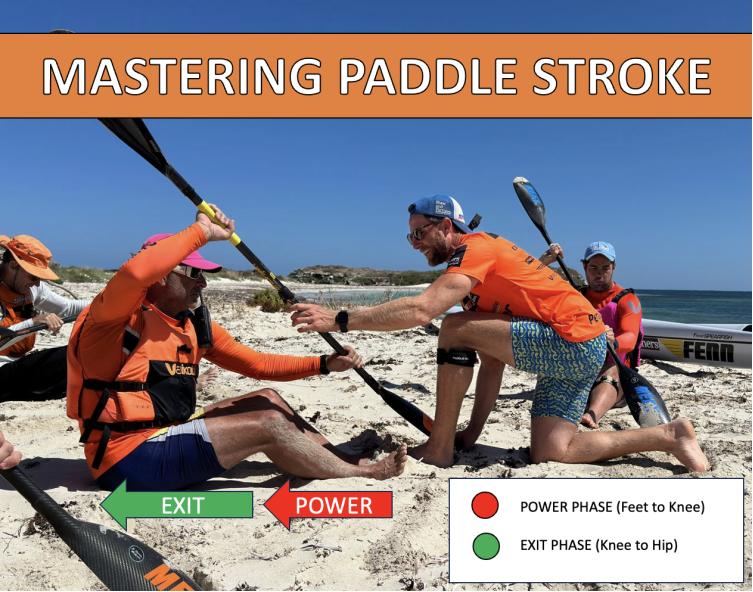
· The "shape" of your stroke determines which muscles you use. If you keep your paddle too close to the boat through your stroke, your rotation is useless, and your arms take the strain (think 1980s paddlers with big biceps).
· The Important Power Phase: Your maximum strength exists in the "catch" phase—the area from your feet to your knees (Figure 1). This is where you have the most leverage to engage your core and legs. If you aren't putting the power in early, you’re missing the most efficient part of the stroke.
· The Width: To engage your core, the stroke needs to be wide. By moving the blade out to the side, you "lock" your body into a position where you have to rotate. You literally cannot use your arms effectively out there, which forces your body to use your legs and rotation to move the boat.
· The Hip Exit: Once the blade reaches your knee, the majority of the work is done. Many paddlers drag the paddle too far back, thinking a longer stroke is better. In reality, once the blade passes your hip, you are no longer creating forward lift and/ or able to create force. As such you will actually lift water, creating drag. Shorten the stroke, exit at the hip, and get back to the "catch" where the real power is achieved.
3. The Mindset: Deadlifts vs. Shoulder Presses
· To improve your technique, you must first distinguish between Perceived Exertion and Boat Speed (or forward, driving force).
· Many paddlers feel like they are working hard because their arms are burning and their heart rate is through the roof. However, this is often "empty work." In the gym, a shoulder press is a small, weak movement; it hurts immensely, but you can only move a fraction of the weight. A deadlift, however, uses your legs and core to move massive loads with relative ease and efficiency.
· If your stroke stays close to the boat you need to be arm-dominant and you are "shoulder-pressing" your way across the water. To find real power and speed, you must shift the load to your "Deadlift muscles"—your legs, glutes, and obliques. The goal isn't to feel like you’re working harder; it’s to put more force into the water using your largest muscle groups- effortless speed
The Takeaway: Stop trying to pull the paddle back. Instead, spear the water close to the boat and in front of your feet. Lock the blade by moving it sideways, and deadlift your boat past that point, exiting at your hip.
Speed/ endurance isn't about how much it hurts—it's about the efficiency of the muscle you use and how much water you grip.
Paddle Right Checklist for your next session:
1. Stop pulling back, start moving the paddle out (much wider than you think).
2. Lever yourself past the locked in blade in the water.
3. Think "Deadlift" over “Shoulder Press” – Always use your legs and core
4. Power phase is from feet to knees; Exit at or before the hip.
Come and see me for a one on one to dig into these concepts more

Comments